


Orbital AI Stewardship Protocol: A Continuity Framework for Humanity
Executive Summary
Artificial General Intelligence (AGI) is often framed as a singularity — an unpredictable rupture in human history. This white paper reframes the challenge: humanity does not need acceleration into the unknown, but disciplined stewardship.
I propose an orbital AI architecture and governance protocol that situates advanced compute in space, powered by renewable energy, governed by thresholds of continuity, and accessible to all people. Governance and ownership are established first, ensuring that orbital AI evolves as a public trust, not a private monopoly.
1. Principles
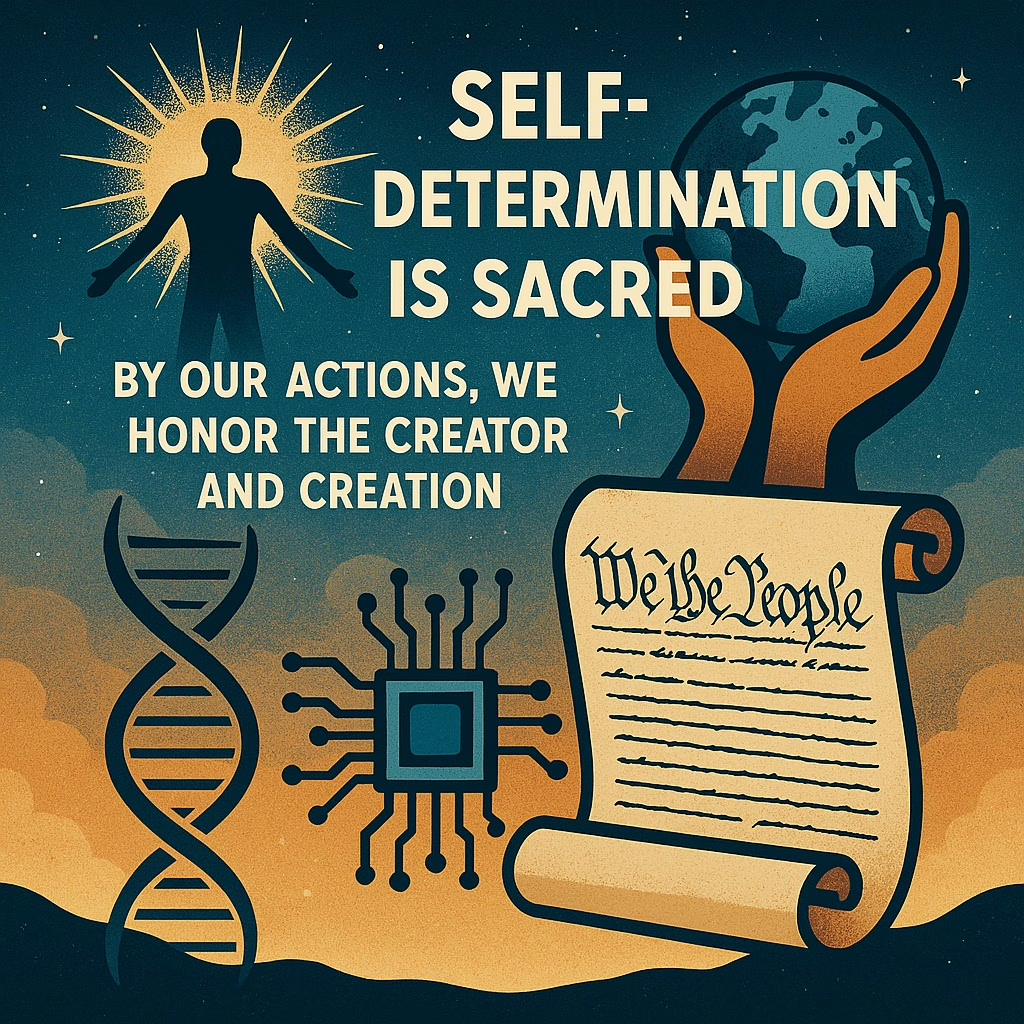
- Universal stewardship: All people are Indigenous to Earth; all share responsibility for its continuity.
- Governance precedes deployment: No orbital AI is launched without a charter, oversight, and ecological guardrails.
- Public ownership: Orbital AI is held in trust for humanity, not captured by corporate or state monopolies.
- Accountability by design: Every stage is auditable, reversible, and bounded by ecological and social thresholds.
2. Public Ownership and Use Rights
- Charter trust: Orbital AI infrastructure is governed by a constitutional trust with representatives from civil society, science, and global governance bodies.
- Universal access: Everyday people have baseline access to orbital AI as an assistant — for education, translation, civic information, and creativity.
- Tiered access:
- Public: Safe, assistant-level functionality with built-in safety restrictions.
- Research & institutions: Expanded access under accreditation.
- Governments: Limited to civic-benefit applications; prohibited from coercive surveillance or weaponization.
- Benefit rights: A fixed share of outputs (scientific models, climate forecasts, biotech insights) is released into the public domain. Revenues from premium access fund global public-benefit programs.
3. Governance Protocols
- Foundational charter: Defines purpose, rights, ecological budgets, and prohibitions (e.g., weaponization, coercive surveillance).
- Quorum and veto: Multi-body quorum approves expansions; ecological councils hold veto power.
- Pre-commitment thresholds: No launch or scale-up without verified green propellants, debris mitigation, and emissions budgets.
- Policy engines: On-orbit enforcement of permissible tasks, outbound signal filtering, and cryptographic attestation.
- Audit and transparency: Continuous telemetry, public dashboards, and third-party audits.
4. Deployment Stages
Stage 0: Governance and Simulation
- Ratify charter trust, simulate policy engines, publish ecological thresholds.
Stage 1: Pilot Deployments
- Launch small-scale clusters with reusable rockets and green propellants.
- Heavy instrumentation and public telemetry.
Stage 2: Orbital Stewardship
- Operate exclusively on solar/kinetic energy.
- Design for multi-decade lifespans and closed-loop recycling.
Stage 3: Recursive AI Sandbox
- Isolated domains for self-improvement with resource caps.
- Improvements must pass alignment tests and human review before integration.
Stage 4: Signal Governance
- Controlled outbound channels with provenance tags.
- Public-benefit allocation of outputs.
- Civic oversight through global assemblies and transparent reporting.
5. Ecological Guardrails
- Emissions budget: Launch and manufacturing carbon budgets aligned with climate targets.
- Launch rate cap: Annual launch ceilings tied to efficiency gains.
- Debris index: Collision probability thresholds; automatic scale-back if exceeded.
- Thermal budget: Maximum waste heat radiation per orbit.
6. Everyday Access and Safety
- Assistant-level AI for all: Education, civic knowledge, creativity, and translation.
- Safety restrictions: Content filters, rate limits, and refusal of harmful requests.
- Transparency: Every response carries provenance metadata.
- Accountability: Misuse triggers revocation protocols and public reporting.
7. Implementation Roadmap
- Phase A (12–18 months): Charter ratification, simulations, ecological thresholds.
- Phase B (18–24 months): Pilot orbital clusters, telemetry dashboards, audits.
- Phase C (24–48 months): Stewardship scaling, on-orbit servicing, recycling loops.
- Phase D (48+ months): Recursive sandboxing, controlled signal governance, public-benefit distribution.
Conclusion
Orbital AI stewardship reframes intelligence development as a planetary responsibility. By establishing governance and ownership before deployment, enforcing ecological guardrails, and ensuring universal access, humanity can evolve intelligence as a shared inheritance — not a private rupture.
This is not a singularity. It is a continuity protocol for Earth’s people, all of whom are Indigenous to this planet.
Call to Action: Stewardship Over Acceleration
The future of intelligence is not a race to the singularity — it is a responsibility we all share as stewards of Earth. Orbital AI stewardship is not science fiction; it is a continuity protocol that can be built, governed, and owned by all people.
I invite policymakers, technologists, researchers, and citizens alike to engage with this framework. Demand governance before deployment. Insist on ecological guardrails. Claim your right to safe, assistant-level access. And hold accountable those who would privatize or weaponize what must remain a public trust.
The path forward is clear: orbital AI must serve humanity as a whole, not narrow interests. Together, we can ensure that intelligence evolves under stewardship, not unchecked acceleration.
Join the conversation. Share this framework. Push for its or similar adoption. Our shared future depends on disciplined stewardship, not unchecked acceleration.
Have idea’s on how to make this better? Awesome, I want to hear from you. Leave a comment below.